Bonsai Terms Every Beginner Should Know (A Plain Glossary)
A plain-language bonsai terms glossary covering nebari, jin, shari, and more, everything beginners need to understand guides and conversations.
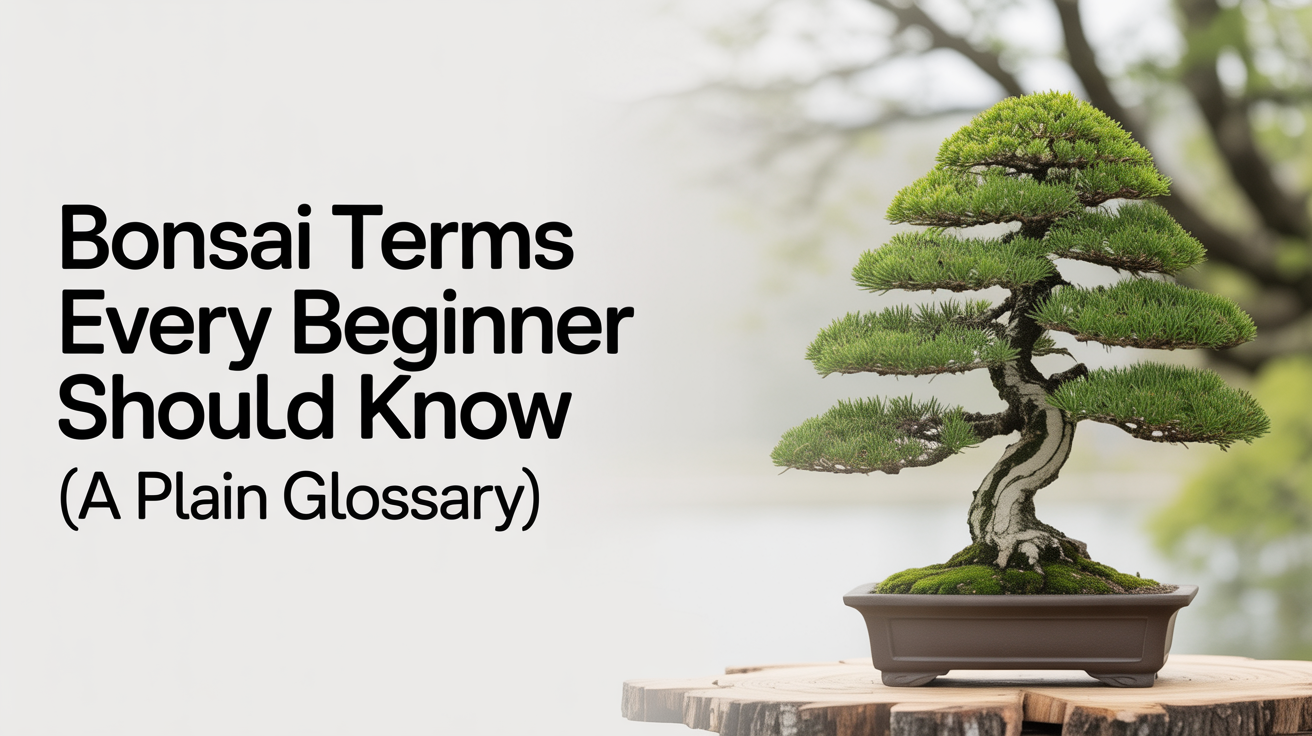
Picking up a bonsai guide for the first time and hitting words like nebari, apex, or deadwood can make the hobby feel more exclusive than it actually is. This glossary covers the terms you will meet most often as a beginner, explained plainly so you can follow along with books, videos, and club conversations without stopping to look things up every few minutes.
Tree Structure: The Parts of a Bonsai
Understanding how practitioners talk about the tree's physical structure helps you follow care instructions and discuss your tree with other growers.
| Term | Plain meaning |
|---|---|
| Nebari | The surface roots that fan out from the base of the trunk at soil level. A strong, visible nebari is considered a sign of a well-developed tree. |
| Trunk (Taichi) | The main stem. When growers describe trunk taper, they mean the trunk is thicker at the base and gradually narrows toward the top. |
| Apex | The very top of the tree. In most styles this is the highest point of the design. |
| Primary branch | One of the first large branches growing off the trunk. These set the main silhouette. |
| Secondary branch | Branches that grow off primary branches and add interior detail and foliage mass. |
| Pad | A flattened, layered cloud of foliage grown on a branch. Pads are built up over many growing seasons. |
| Back branch | A branch growing toward the viewer rather than left or right. Used sparingly, it adds depth. |
| Ramification | The fine branching you get when a branch divides repeatedly. High ramification produces the delicate, tree-like silhouette prized in mature bonsai. |
Deadwood: Jin, Shari, and Uro
Deadwood features appear on many trees in nature when branches die, bark is stripped by wind, or lightning scars the trunk. In bonsai these features are preserved and sometimes created deliberately to suggest great age.
Jin refers to a stripped, dead branch tip. When a branch is removed, the bark is stripped back to expose the bare wood, which is then treated and preserved. The result looks like a bleached, weathered branch stub.
Shari is stripped dead bark running along the trunk itself, rather than on a branch. A long shari can make a young tree look as though it has survived decades of harsh weather.
Uro is a hollow or carved cavity in the trunk, also treated to represent storm damage or the mark of a long life.
All three are treated with lime sulfur solution to bleach the wood and prevent rot. This is not a technique for the first week with your tree, but knowing what the terms mean helps when you read styling guides or watch demonstrations.
Bonsai Styles
Practitioners use Japanese terms to describe the basic silhouette of a tree. You do not need to memorize all of them, but these five come up constantly.
Chokkan (formal upright), the trunk grows straight and vertical, tapering evenly. Clean, classical, and a good starting shape to practice on.
Moyogi (informal upright), the trunk curves gently but the apex sits roughly above the base of the trunk. This is the most common style for beginners because many nursery stock trees already have a natural curve.
Slant (Shakan), the trunk grows at a visible angle, but the roots and lower trunk lean in opposite directions from the crown to balance the composition.
Cascade (Kengai), the apex falls below the rim of the pot. Cascades suit species that naturally grow on cliff edges.
Semi-cascade (Han-kengai), the apex drops below the rim of the pot but does not fall below the bottom of the pot. A gentler version of the cascade.
Technique Terms You Will Meet in Care Guides
These are the words that appear in pruning, wiring, and growing instructions.
Back-budding, when a branch or trunk produces new buds lower down toward the trunk after the growing tip is removed. Good back-budding gives you more options for branch placement.
Decandling, a technique used on pines where the new spring growth (candles) is cut back to encourage a second flush of shorter, more compact needles.
Defoliation, removing all or most of the leaves from a deciduous tree mid-season to encourage smaller replacement leaves and improved ramification. Not suitable for weak trees or conifers.
Deadheading, removing spent flowers to redirect energy from seed production back into the tree.
Leggy, informal but common. A tree or branch is described as leggy when it has grown long and bare with foliage only at the tips. The fix is usually to cut back to a lower node.
Node, the point on a stem where a leaf or bud attaches. When you cut back to a node, you leave the tree a spot to push a new bud.
Internode, the length of bare stem between two nodes. Short internodes are generally desirable in bonsai because they keep the growth compact.
Pot and Soil Vocabulary
Bonsai pot (Tokoname), Tokoname is a Japanese city famous for its ceramics and is also used loosely as a synonym for a quality bonsai pot. Any pot designed for bonsai works; the term just signals it is sized and drained correctly.
Training pot, a plain, practical container used while a tree is still developing, before it is moved to a display pot. Usually deeper and less expensive.
Akadama, a fired Japanese clay used as part of bonsai soil mixes. It holds some moisture while staying open enough for good drainage and air to roots. Often blended with pumice and a gritty amendment like fine gravel or kiryu.
Pumice, a volcanic rock that improves drainage and aeration in bonsai soil. Common in most recommended beginner mixes.
Root bound, when roots have filled the pot so completely that growth slows and the tree needs repotting.
Frequently Asked Questions
What does nebari actually look like, and why does it matter? Nebari is the spread of surface roots radiating out from the base of the trunk. On a tree with good nebari, you can see several roots fanning outward like the base of an old oak. It matters mainly for aesthetics: it gives the tree a planted, grounded look. Developing nebari takes years and is done by encouraging surface roots while removing downward-growing ones during repotting.
Do I need to learn Japanese to understand bonsai? You will run into Japanese terms regularly because so much of the written tradition comes from Japan. This glossary covers the terms beginners meet most. You do not need to memorize all of them at once. Pick up the words that appear in whatever you are currently learning to do, and the vocabulary builds naturally over time.
What is the difference between pruning and pinching? Pruning means cutting branches or stems back with scissors or shears to reshape the tree or reduce its size. Pinching means removing new growth with your fingernails or tweezers while it is still soft and green, which is a lighter, more frequent task done during the growing season to keep the silhouette tidy without cutting into mature wood.
What does "reading the tree" mean? Growers use this phrase to describe the process of studying a tree before deciding how to style or work it. You look at the movement of the trunk, the natural placement of branches, and the strongest nebari to figure out the best front of the tree and what structure to build on. It is mostly about slowing down and observing before picking up scissors.
Is akadama necessary or can I use regular potting soil? Standard potting soil holds too much water for most bonsai and will compact over time, which suffocates roots. Bonsai soil mixes need to drain fast and stay open. Akadama is one good option, but a mix of coarse pumice, fine pine bark, and crushed granite or perlite can work well and is often cheaper. The key is drainage, not any particular brand name. If you are just getting started, a well-draining pre-mixed bonsai substrate is a reasonable starting point.
Getting comfortable with bonsai vocabulary is mostly a matter of time spent reading and watching. If you are still figuring out where to begin with your first tree, the guide on what bonsai really takes for beginners covers the practical side before the terminology becomes relevant. Once you have a tree in hand, you will find that most of these words start to feel natural quickly.