Copper vs Aluminium Bonsai Wire: Which to Use
Learn when to use copper vs aluminium bonsai wire, how they differ in strength and grip, and which is best for beginners.
Most beginners buy the first bonsai wire they see and hope for the best. It mostly works out, but understanding the difference between copper and aluminium wire will save you from snapping branches, scarring bark, and wasting money on wire that's too stiff or too soft for what you're trying to do.
The short answer: aluminium wire is the better starting point for almost every beginner. It's easier to handle, widely available, and forgiving of small mistakes. Copper wire is stronger per thickness, holds a bend more firmly, and is the right choice for certain trees, but it's trickier to use and less necessary when you're still learning the basics.
Read on to understand why, and when you might eventually reach for copper instead.
At a Glance
- Aluminium is the right default for beginners. It's soft, forgiving, cheap, and handles most deciduous and tropical species well.
- Copper is roughly twice as stiff per diameter, so a thinner copper wire matches a thicker aluminium wire's holding power. It's the traditional choice for pines and other conifers.
- Copper hardens after application; aluminium doesn't. That means copper holds its grip longer but also bites into bark faster if you forget to check it.
- A starter set of four aluminium gauges (1.0, 1.5, 2.0, and 3.0 mm) covers the vast majority of beginner work.
- Check wired branches every four to six weeks on fast-growing trees, and remove wire the moment it looks snug against the bark.
- Never use florist, garden tie, or electrical wire. Gauges are unreliable and the metal isn't annealed for bending.
How the two wires actually differ
The practical differences come down to stiffness, working behaviour, and how each wire sets into a branch over time.
Stiffness and holding power
Copper wire is roughly twice as stiff as aluminium wire of the same diameter. That means you can use a thinner copper wire to achieve the same holding force as a thicker aluminium wire. A 1.5 mm copper wire can do what 2.5 mm aluminium wire does. In practice this matters most on stiff, older branches that need real force to bend, and on trees like pines whose bark is too delicate to risk a thick wire pressing in.
Aluminium wire is softer and more pliable. It bends easily by hand without much risk of kinking. For most deciduous trees and young material with flexible branches, it holds a bend just fine through a single growing season.
How they set
Once applied and left on a growing tree, both wires "set" as the wood thickens through secondary growth around them. Copper hardens after application, so it keeps its grip better than aluminium, which can loosen a little if a branch grows vigorously. This is one reason professional growers favour copper on conifers, which hold wire for two years or more.
For a beginner, the longer setting time of conifers is also what makes copper tricky: if you leave wire on too long, those hardened copper coils bite deeply into bark. Aluminium is a bit more forgiving because it softens rather than hardens over time.
Feel in the hand
Copper wire is stiffer out of the coil and can be awkward to wrap precisely when you're new. Aluminium bends where you want it to, almost like thick garden wire. Most people find it far easier to get a clean 45-degree spiral going with aluminium on their first few attempts.
Which trees suit which wire
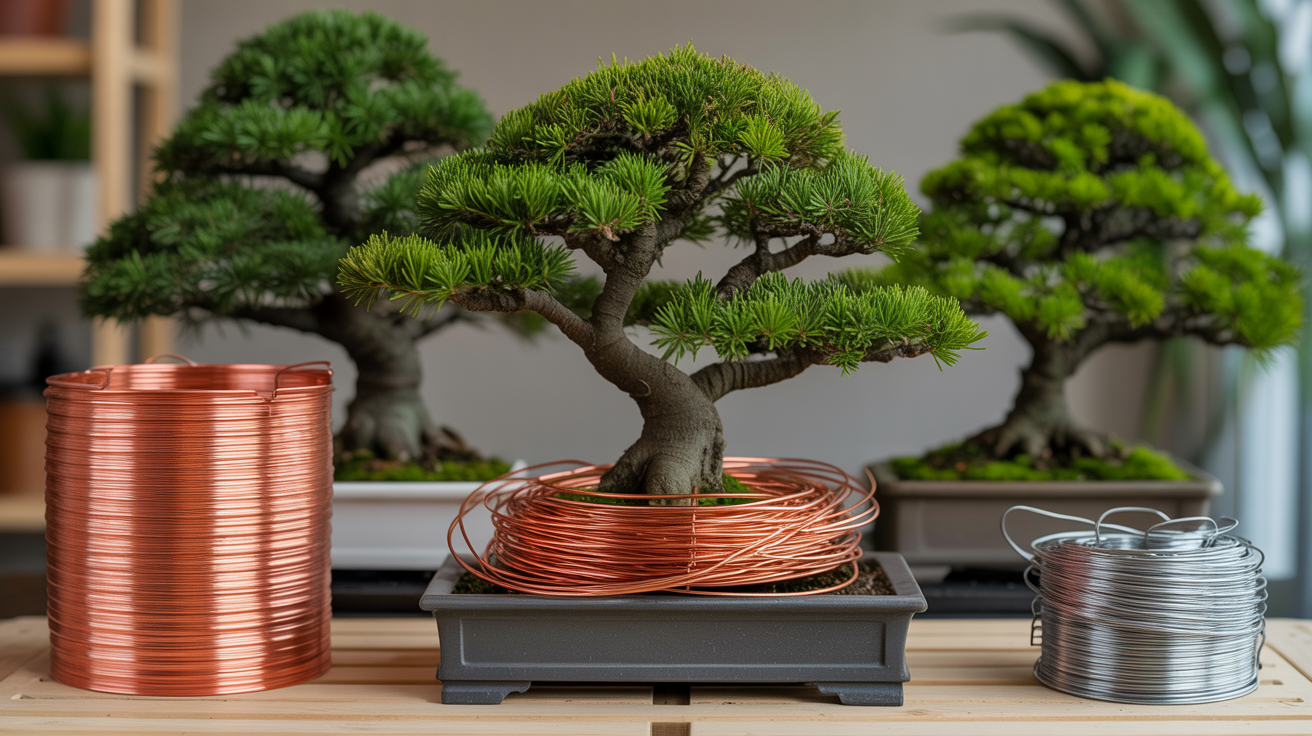
This is not a strict rule, but the general guidance used by most practitioners:
| Tree type | Recommended wire |
|---|---|
| Deciduous trees (maples, elms, hornbeam) | Aluminium |
| Tropical indoor trees (ficus, jade) | Aluminium |
| Junipers (most common beginner conifers) | Aluminium or copper |
| Pines (black pine, Scots pine) | Copper preferred |
| Azalea | Aluminium (bark scars easily) |
| Thick, rigid branches on any species | Copper (or double aluminium) |
If your first tree is a juniper or a deciduous species, aluminium wire will do the job well. If you eventually work with pines or want to wire old, woody branches with precision, copper will earn its place in your kit.
Choosing the right gauge
Wire gauge matters as much as material. Too thin and the branch springs back; too thick and you risk cracking the wood or bruising the bark. A good starting set for beginners includes four sizes: 1.0 mm, 1.5 mm, 2.0 mm, and 3.0 mm.
A rough rule of thumb is that the wire should be about a third of the branch's diameter for aluminium, since the wire needs enough mass to resist the branch springing back once bent:
| Branch diameter | Aluminium gauge | Copper gauge |
|---|---|---|
| Fine shoots, under 3 mm | 1.0 mm | 0.8 mm |
| Small twigs, 3 to 6 mm | 1.5 mm | 1.0 to 1.2 mm |
| Medium branches, 6 to 10 mm | 2.0 mm | 1.5 mm |
| Heavy branches, 10 to 15 mm | 3.0 mm, or double 2.0 mm | 2.0 mm |
| Trunk-level movement, over 15 mm | Double or triple wire | 2.5 to 3.0 mm |
For most small-to-medium deciduous branches, 1.5 mm or 2.0 mm aluminium wire handles the work comfortably. Thin, delicate twigs might call for 1.0 mm. A heavy trunk movement needs 3.0 mm or doubling up two thinner wires side by side.
If you're choosing copper, subtract roughly one size, as the table above shows. What 2.0 mm aluminium does, 1.5 mm copper can usually match. Our guide on what wire gauge to use on a bonsai goes deeper into the sizing decisions.
Practical tips for applying bonsai wire
A few things that will save you time and frustration:
- Anchor before you wrap. Wedge one end of the wire behind a branch or root, not just resting on the soil surface. An unsecured end spins free the moment you start coiling.
- Aim for a 45-degree spiral. Too steep (60 degrees or more) and the wire grips poorly. Too shallow (30 degrees or less) and you need far more wire to cover the same length. Practice on a twig first.
- Avoid crossing wires over bare bark. Where two wires cross, pressure concentrates and scars form faster. Plan your routing before you start.
- Check after 4 to 6 weeks on fast-growing trees. Young deciduous trees in a good growing season can fatten a branch noticeably in a month. Aluminium loosens before it bites; copper does not.
- Remove carefully. Cut in short segments rather than unwrapping. Unwrapping risks bending the branch back and snapping it.
The full technique is covered in our beginner's guide to wiring a bonsai tree, including how to handle branch junctions and what to do when a branch resists bending.
Cost and where to find it
Both wire types are available from bonsai suppliers and online retailers. Aluminium is cheaper and more widely stocked. A 500 g roll of quality aluminium wire typically costs less than a 500 g roll of copper of the same diameter, and the aluminium roll will have more metres on it, since copper is denser and heavier by volume.
Copper wire is worth the extra expense once you know you'll use it regularly on pines or tough older material. It lasts indefinitely stored in a dry spot, so buying a few key sizes is a one-time investment. A useful starter budget is one small roll each of 1.0 mm and 1.5 mm copper alongside the four-gauge aluminium set, which covers the pine and juniper work most beginners eventually try.
Avoid florist wire, garden tie wire, or cheap electrical wire. These are not annealed the same way bonsai wire is, and the gauges are often not labelled accurately. Dedicated bonsai wire is sold in known gauges, which makes matching wire to branch far more predictable.
Bark scarring: the risk with both wires
Left on too long, any wire will scar. The scar is permanent and often shows as a spiral groove in the bark for years, or permanently in smooth-barked species. Copper is more likely to scar because it hardens over time; aluminium is more forgiving but not scar-proof. What's happening under the wire is essentially girdling on a small scale: a tight band around the stem restricts the flow of nutrients through the bark's outer layer, and if the coil bites deeply enough on a thin branch, it can cut off that flow entirely rather than just leaving a cosmetic mark.
This is also why serious bonsai practice treats wire as temporary scaffolding rather than a permanent fixture. The convention among practitioners is that wiring should leave no permanent marks on the branch or bark, and should ideally be removed or concealed by the time a tree is shown. A tree with visible wire scars reads as unfinished work, not just a technical slip.
Our article on how to apply bonsai wire without scarring the bark covers the timing and technique for removing wire before damage occurs. The basic rule: check frequently, remove the moment the wire looks snug against the bark, and re-wire if the branch hasn't set.
Frequently asked questions
Can I use aluminium wire on pines?
You can, especially as a beginner learning the technique. Aluminium holds a bend through a full growing season on most pines. However, copper is preferred for pines in more advanced work because it holds with a thinner profile and hardens in place, which is valuable on trees wired for two or more years between repotting cycles.
What is the best bonsai wire for beginners?
Aluminium wire in a starter set of four gauges (1.0, 1.5, 2.0, and 3.0 mm) is the most practical choice. It's easier to wrap cleanly, more forgiving if you leave it on a week too long, and less likely to kink or snap a branch if you apply it imperfectly. Most experienced growers still reach for aluminium on their deciduous trees.
How long can I leave wire on before it scars?
It depends on the species, the time of year, and how fast the tree is growing. On a vigorous young maple in full summer growth, four to six weeks is about the limit before the wire tightens noticeably. On a pine in slow autumn growth, the same wire might sit safely for a full year. Check every few weeks during the growing season rather than working on a fixed schedule.
Do I need to coat the wire before applying it?
No. Bonsai wire is used bare. Some growers wrap delicate bark with raffia first to cushion the wire, but the wire itself is applied directly. Coating it would reduce the grip and make the spiral harder to maintain. If a branch is very thin and tender, use a lighter gauge rather than trying to pad a heavier one.
Is there a difference between Japanese bonsai wire and other brands?
Annealed aluminium and annealed copper wire from reputable bonsai suppliers should perform similarly regardless of origin. What matters is that the wire is properly annealed (softened for flexibility), labelled by true gauge, and round in cross-section. Cheaper wire sometimes has inconsistent gauge, which makes choosing the right size harder. Buying from a dedicated bonsai supplier rather than a hardware store is worth the small premium.
How much wire do I actually need to buy to start?
For a first tree, a single small roll (around 100 to 150 g) of each of the four core aluminium gauges is plenty, and most of it will last through several trees since a typical wiring session uses only a few metres. Buying large rolls upfront is rarely worth it until you know which gauges you reach for most.
My wire already looks like it's cutting in slightly. Should I remove it now or wait?
Remove it now. A little indentation that hasn't broken the bark will usually smooth out within a season once the wire is off. Left on longer, the same indentation deepens into a permanent scar. When in doubt, take the wire off and re-wire loosely if the branch still needs guidance, rather than leaving marginal wire in place and hoping it's fine.