The Main Bonsai Styles Explained for Beginners
Learn the classic bonsai styles for beginners, formal upright, cascade, slanting, and more, so you can match any tree to its natural shape.
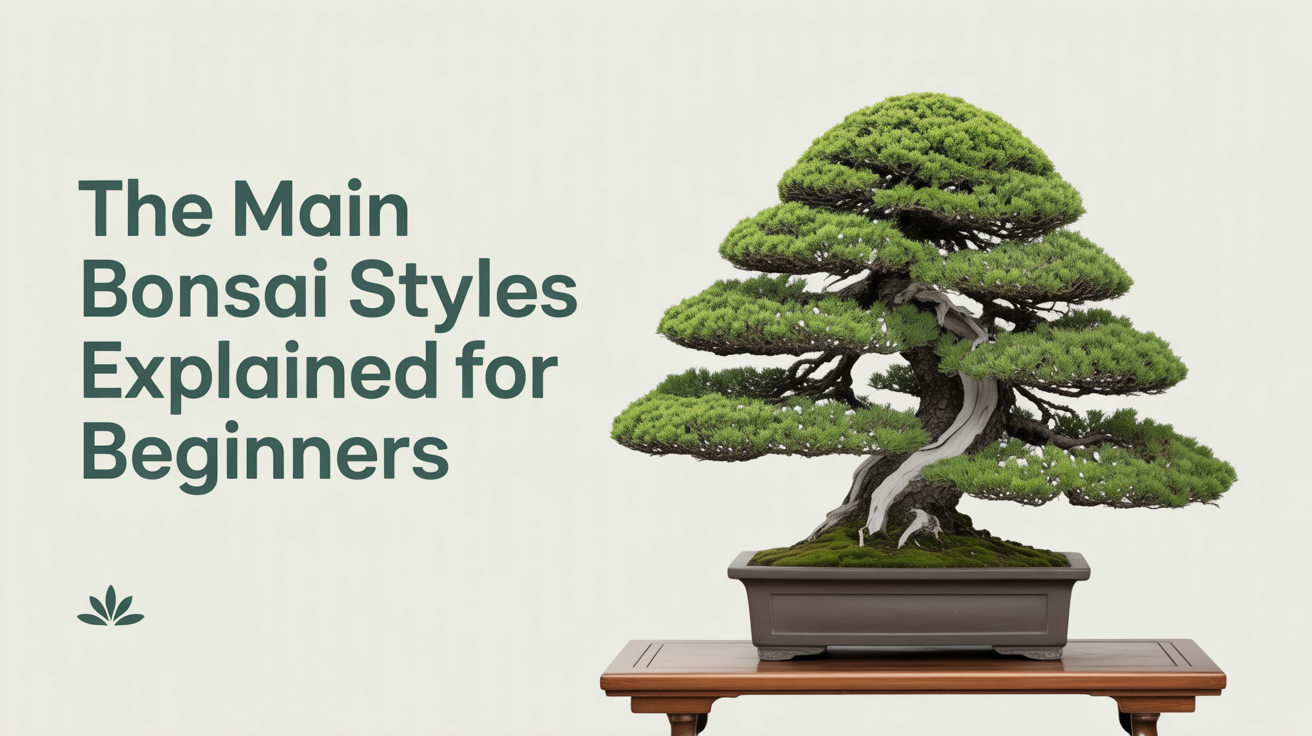
Bonsai styling is about reading what a tree wants to become, then guiding it there. Before you reach for wire or scissors, it helps to know the five foundational styles that bonsai practitioners have used for centuries. Each one mimics a way trees actually grow in nature, and once you can name them, choosing a direction for your own tree gets much easier.
Why Bonsai Styles Matter
A style is not a rigid rule. It is a framework that gives your design a focal point. Knowing the style you are aiming for helps you decide which branches to keep, where the trunk should lean, and how to position the pot. Without that target, pruning and wiring a bonsai tree can feel like guesswork.
Styles come from Japanese tradition but draw on how trees survive wind, gravity, and competition in the wild. The names below are the Japanese terms, though most nurseries also use the English equivalents.
The Five Classic Bonsai Styles at a Glance
| Style (Japanese) | Trunk Angle | Best Beginner Tree |
|---|---|---|
| Chokkan (Formal Upright) | Straight, 90° | Juniper, pine |
| Moyogi (Informal Upright) | Curved, roughly upright | Ficus, Chinese elm |
| Shakan (Slanting) | 45–60° lean | Juniper, trident maple |
| Kengai (Cascade) | Drops below pot rim | Cotoneaster, juniper |
| Han-Kengai (Semi-Cascade) | Drops to pot rim level | Juniper, wisteria |
These five cover the vast majority of trees you will encounter at a nursery or bonsai club sale.
Formal Upright (Chokkan)
The formal upright is the most structured of the classic types. The trunk rises perfectly straight from the soil and tapers evenly toward the apex. Branches radiate outward in a triangular silhouette, with the lowest branch being the longest and each successive layer becoming shorter as the tree climbs.
In nature, formal upright trees grow in open ground with consistent light and no strong prevailing wind. Pines and larches that grow on flat, protected terrain are the real-world models.
For beginners, formal upright bonsai styles are a good starting point because the rules are clear: straight trunk, tapering silhouette, lowest branch positioned about one-third up the trunk. Mistakes are easy to spot and correct.
Choosing a tree for formal upright
Conifers generally suit this style well. A young juniper with a naturally upright trunk and moderate branch density is a practical first choice. Avoid species with trunks that bend dramatically, since straightening a mature curve takes years.
Informal Upright (Moyogi)
The informal upright is the most common style in home collections. The trunk curves gently left and right as it rises, with the apex sitting directly above the base of the trunk when viewed from the front. Each curve gives the design energy without making the tree look wind-battered.
This mirrors how many trees grow in mild, slightly competitive environments, bending subtly toward available light. Ficus, Chinese elm, and hornbeam all suit this style naturally.
Informal upright is forgiving. The curves give you room to hide imperfect branch placement or early wiring mistakes within the overall movement of the trunk. It is probably the most common starting point for people who find formal upright too rigid.
Slanting Style (Shakan)
A slanting bonsai leans between 45 and 60 degrees from the vertical. The lean should look deliberate, as if the tree has grown that way over a long time in response to a slope or persistent wind. The roots on the side opposite the lean should be visible and prominent, anchoring the design visually.
The key distinction from a windswept style is that the branches in a slanting design are not all swept in one direction. They radiate normally; only the trunk leans.
Wiring is often central to achieving a convincing slanting style. A tree that is naturally upright can be repositioned in its pot at an angle and then trained with wire to keep the apex and branches balanced. See which wire to use on a bonsai before you start, since the trunk base of a slanting tree often needs heavier gauge than you might expect.
Cascade (Kengai) and Semi-Cascade (Han-Kengai)
The cascade bonsai style is striking: the main line of the tree falls below the rim of the pot, sometimes well below it. This mimics a tree growing on a cliff face or steep riverbank, where the trunk and primary branch have been dragged downward by gravity and snow load over decades.
Semi-cascade stops at roughly pot-rim level. The trunk still dips, but the apex does not fall far below the pot base.
Both cascade styles are placed on tall stands or the edge of a surface so the trailing branch has room to hang freely. They work well with flowering species like cotoneaster or wisteria, where the cascade position puts the blooms on full display.
What beginners should know about cascade
Cascade styling takes patience. Getting a trunk to arc convincingly downward usually requires years of progressive wiring. Starting with a naturally pendant branch or a young nursery plant with a flexible trunk is easier than trying to bend a rigid, established trunk. Wire gauge matters here because thin wire on a thick cascading section will not hold the angle and may cause the branch to spring back.
Matching a Style to the Tree You Already Have
If you have a tree in front of you and are unsure which style fits, turn the pot slowly and look at the trunk from every angle. The best front is usually the one where the trunk line has the most movement and the nebari (surface roots) look most balanced.
Ask yourself:
- Does the trunk rise straight? Consider formal or informal upright.
- Does it lean noticeably to one side? Slanting or even cascade may suit it.
- Is there a long, flexible branch that naturally droops? A cascade design might already be waiting.
No style is wrong for any species. That said, some combinations are more common because the growth habit of the tree and the style reinforce each other visually. Observe your tree through a full growing season before committing to a major styling session.
Frequently Asked Questions
Do I have to pick one style and stick with it? You do not. Many trees are restyled over time, especially as the trunk thickens and the overall character of the tree changes. Choosing a style is a starting point for training, not a permanent contract. That said, working toward a clear style produces better results than making unconnected cuts each season.
What is the easiest bonsai style for an absolute beginner? Informal upright is the most forgiving because the natural curves of the trunk give you flexibility. Formal upright requires a straight, well-tapered trunk that is hard to find in a nursery seedling. Cascade is the most technically demanding because it relies on long-term wiring to hold an unnatural angle against gravity.
Can I change my tree from one style to another? Yes, with time. Shifting from informal upright to slanting, for example, mainly involves repotting the tree at an angle and adjusting the branch work over one or two growing seasons. Moving a mature tree into full cascade is harder and is best treated as a multi-year project.
How does the pot shape relate to bonsai styles? The pot should reinforce the style, not fight it. Formal upright trees typically sit in rectangular or square pots that echo the structured lines of the design. Cascade trees are traditionally planted in tall, drum-shaped pots that give the falling branch room to descend. Round or oval pots suit softer, more naturalistic informal upright designs.
Where can I see these styles in practice? Local bonsai clubs are the fastest way to see a range of styles on living trees. Most clubs hold annual exhibitions and welcome beginners. Seeing how a 20-year-old formal upright differs from a same-age informal upright gives you a feel for proportion that photographs rarely convey.