Common Bonsai Myths Beginners Should Ignore
Sorting bonsai fact from fiction so you stop worrying and start growing. The most common myths — debunked plainly.
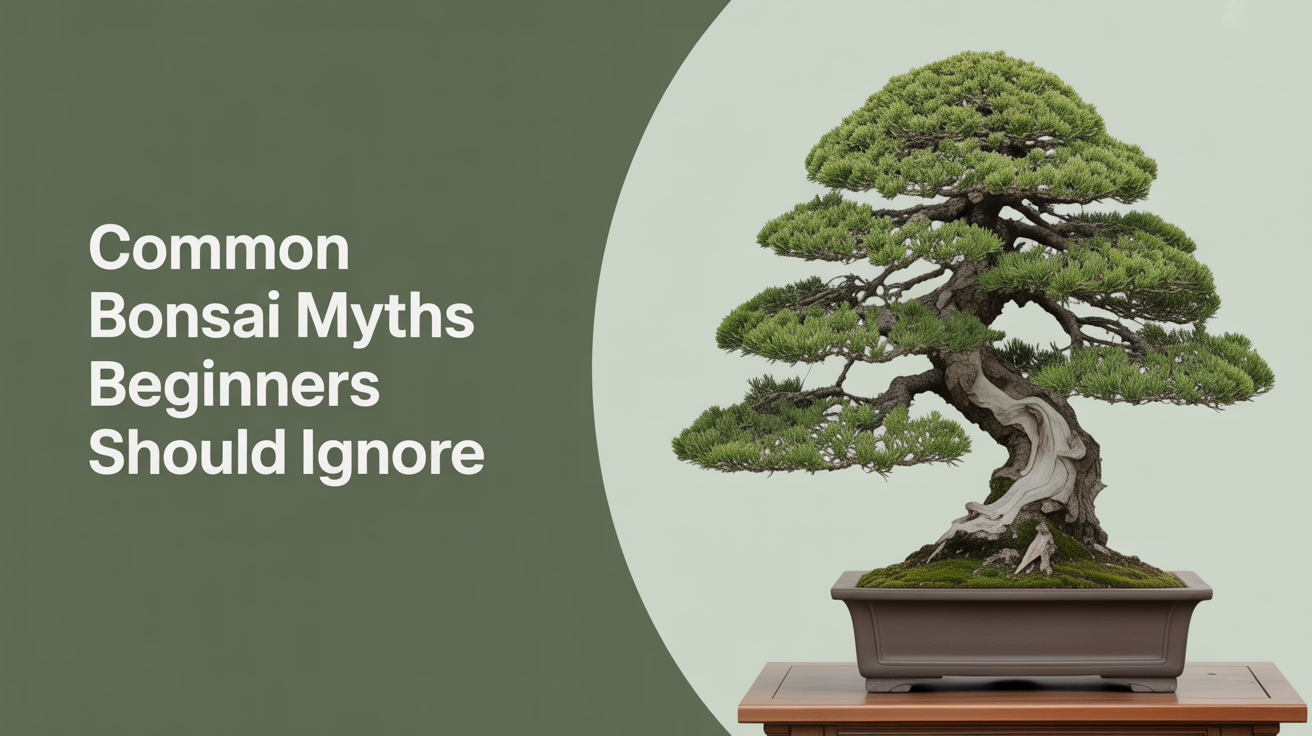
Bonsai has picked up more misinformation than almost any other hobby. Some myths scare people away before they ever buy a tree. Others give new owners a false sense of security right up until the tree dies. Before you go any further, it's worth setting the record straight on the ones that come up most often.
The short answer: bonsai are real trees, not stunted ones. They're not suffering. They don't stay small on their own. And with a bit of honest effort, they're not nearly as fussy as people claim.
Myth 1: bonsai trees are genetically dwarfed
This is probably the most persistent myth in the hobby. People see a tiny maple or juniper and assume there must be something different about it at the genetic level, some special bonsai variety engineered to be miniature.
There isn't. Bonsai trees are completely normal trees from completely normal species. A Japanese maple grown as a bonsai is the same tree as a Japanese maple in your garden. Given unrestricted roots, water, soil, and light, it would grow to full size. What keeps it small is the container and the way you manage it: root pruning, canopy pruning, and controlled feeding. Remove those restrictions and the tree will push toward its natural scale.
This matters for beginners because it changes how you think about care. You're not managing a special fragile miniature, you're managing a full-sized tree's growth in a small space. The tree wants to grow. Your job is to guide that growth, not suppress it.
Myth 2: keeping bonsai is cruel
The question "is keeping bonsai cruel?" comes up constantly from people who are new to the hobby or considering it from the outside. It sounds intuitive: a living tree, forced into a tiny pot, roots trimmed, branches wired into unnatural shapes. Surely that's harm?
It isn't, and here's why. Trees don't have nervous systems. They don't experience pain or confinement the way animals do. A bonsai in a healthy pot with good soil, the right light, and regular water is in no distress whatsoever. The tree doesn't "know" it should be 40 feet tall. It responds to the conditions it's in.
What does harm a bonsai is poor care: letting it dry out, keeping an outdoor species indoors, or leaving it in a pot where the roots have circled and starved the tree. That neglect is what actually damages the tree, not the practice of bonsai itself.
The art has been practiced for over a thousand years. Healthy, well-cared-for specimens live for centuries. That's not the story of suffering.
Myth 3: bonsai stay small forever on their own
Newcomers sometimes buy a small bonsai and assume it will just... stay that way. It won't.
Left unpruned, a bonsai will push new growth aggressively. In one growing season, a juniper can add enough growth to lose its entire shape. The tree doesn't maintain its own form. You do, through regular trimming and occasional repotting to manage the roots.
This is actually good news once you accept it. It means the tree is healthy and vigorous. It means you have control over the direction of its development. But it does mean that "buying a bonsai" and "keeping a bonsai" are two different commitments. If you want a small tree that stays small without any work, you're looking for a silk plant, not a bonsai.
For a more grounded look at what's genuinely involved, bonsai for complete beginners: what it really takes lays it out honestly.
Myth 4: bonsai are indoor plants
Walk into any garden center and you'll find bonsai sold next to the houseplants, usually under fluorescent lights in a warm room. This display sends a message that isn't true for most trees.
The vast majority of bonsai species are outdoor plants. Junipers, maples, pines, hornbeams: all of them need full seasonal changes, cold winters, and outdoor light levels to stay healthy. Kept indoors year-round, they slowly decline. The roots overheat, the light is too weak, and the tree can't complete its dormancy cycle. It may look fine for a few months, then suddenly crash.
True indoor species do exist. Ficus, jade, Fukien tea, and Chinese elm (in milder climates) can live indoors with the right light. But they're the exception, not the rule.
If you're not sure whether your tree belongs inside or out, indoor vs outdoor bonsai: which should a beginner choose walks through exactly how to figure that out.
Myth 5: bonsai need special, mysterious care
Bonsai has an image problem. The art looks ancient and arcane, full of precise rules and secret techniques passed down through generations. That image makes beginners feel like they need years of study before they can touch a tree.
In practice, the core care routine is simpler than people expect:
- Water when the soil is approaching dryness, not on a fixed schedule. Stick your finger an inch into the soil. If it's still damp, wait. If it's dry, water thoroughly until it drains from the bottom.
- Give the tree the light it needs. Most outdoor species want full sun or bright partial shade. Most indoor species want a south-facing window.
- Feed during the growing season. A balanced slow-release fertilizer from spring through late summer is enough to start. You can get more precise later.
- Repot every one to three years, depending on species and how fast the roots fill the pot. Spring, just before budbreak, is usually the right time.
That's the foundation. Wiring, advanced pruning, and styling techniques come later, after you've kept a tree alive through a full year and understand how it grows. The basics are learnable in an afternoon.
How to start bonsai: a complete beginner's guide covers the practical first steps if you want a full walkthrough.
What actually kills beginner bonsai (a plain list)
These are the real culprits, not the mythical difficulties people worry about:
| Cause | What happens |
|---|---|
| Underwatering | Soil dries completely; fine roots die; tree can't recover |
| Overwatering in poor-draining soil | Roots rot; tree yellows and collapses |
| Wrong placement (outdoor species indoors) | Slow decline over months, then sudden death |
| No repotting | Roots circle and strangle; tree starves despite feeding |
| Buying a pest-ridden tree | Spider mites and scale spread fast in warm rooms |
| Pruning at the wrong time | Stresses the tree or removes next year's buds |
None of these are mysterious. They're all avoidable once you know to watch for them.
Frequently asked questions
Are bonsai trees hard to keep alive?
For a beginner with a species that matches their conditions, no. The main challenge is understanding that a bonsai needs appropriate placement (outdoor species outside) and consistent watering based on the soil, not a fixed calendar. A hardy outdoor species like a juniper or a cotoneaster is quite forgiving once those two things are right.
Do bonsai trees need a lot of sunlight?
Most do. Outdoor species generally prefer full sun or bright shade. Indoor species need a bright window, ideally south or west facing, and often struggle in dim rooms. Low light is one of the most common reasons indoor bonsai slowly decline.
Can I bonsai any tree?
Technically, almost any woody tree or shrub can be trained as a bonsai. In practice, some species are much easier for beginners than others. Small-leafed, naturally compact species respond better to the constraints of a small pot. Very large-leafed tropical trees can be done but take more skill to make look proportional.
Is it okay to wire a bonsai as a complete beginner?
Yes, with care. Use wire that's roughly half the thickness of the branch you're shaping. Wrap it at a 45-degree angle, snug but not cutting into the bark. Check it monthly and remove it before it bites in. You're not going to ruin a healthy tree by experimenting with wiring, but watch the wire closely during the growing season when branches thicken fast.
Why do my bonsai leaves keep yellowing?
Yellowing leaves usually point to one of three things: inconsistent watering, not enough light, or a root problem (pot-bound or root rot). Check the roots when you water. If the pot feels very light immediately after watering, the roots may have filled the pot so tightly that water is running straight through without being absorbed. That's a sign it's time to repot.