Essential Bonsai Tools for Beginners (and What to Skip)
New to bonsai? Learn which tools actually matter, what to buy first, and what to skip until you're ready for them.
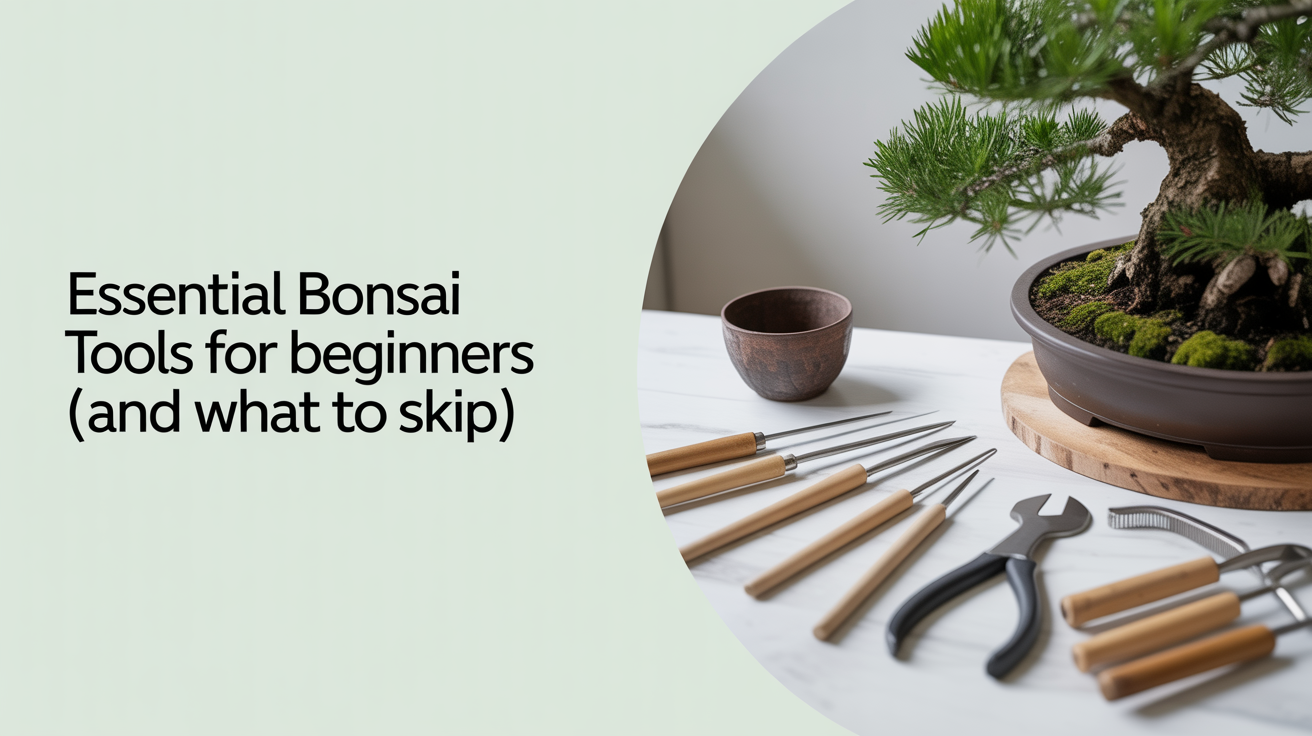
You don't need a full tool cabinet to start bonsai. You need a few good pieces that match what you'll actually do in your first year. Most beginners either buy too little and struggle, or buy a cheap "complete set" that frustrates them. This guide cuts through both problems.
If you're just figuring out what you've gotten yourself into, bonsai for complete beginners: what it really takes is a good place to start before you spend any money on tools.
The short answer: what tools do you actually need?
For a beginner, three tools cover roughly 90% of what you'll do:
- Bonsai scissors (also called shears or trimming scissors)
- Wire cutters designed for bonsai
- A basic soil scoop or chopstick
That's it. Seriously. A pair of quality scissors and wire cutters will take you through your first one or two years without gaps. Everything else is useful, but not urgent.
Bonsai scissors: your most-used tool
Bonsai scissors are different from regular craft scissors or pruning shears. They're narrow, sharp, and built for precise cuts in tight spots between branches. The blades stay close together so they don't tear soft growth.
There are two main styles:
- Standard trimming scissors (sometimes called "butterfly" scissors because of the wider handle loops): good for leaf trimming, thinning shoots, and general shaping work.
- Long-handled or precision scissors: narrower grip, useful for reaching deep into the canopy or cutting roots during repotting.
For a beginner, one pair of standard trimming scissors is enough. Buy the best quality you can afford at that size. A sharp, well-made scissors from a reputable Japanese toolmaker will outlast a whole drawer of cheap alternatives. Dull scissors crush and tear stems instead of cutting cleanly, and that slows healing and invites disease.
Price range to expect: roughly $25 to $60 for a decent starter pair. Anything well under $20 is likely to disappoint.
Wire cutters: don't skip these
Bonsai wire cutters look unusual. They have a round, ball-shaped cutting tip instead of the flat jaw on standard electrician's cutters. That shape matters. When you're removing wire from a branch, a flat jaw would lever against the branch and snap it. The rounded tip cuts the wire with almost no side pressure.
You'll need these once you start wiring branches to shape them. Even if you're not ready to wire yet, having them means you won't be caught off-guard when the time comes.
Don't substitute standard wire cutters. The difference isn't trivial.
Bonsai scissors vs concave cutter: what's the difference?
This is one of the most common questions beginners ask, and it's worth explaining clearly.
Bonsai scissors cut soft growth and small branches, up to roughly pencil thickness. They leave a flat cut.
A concave cutter (sometimes called a branch cutter or hollow cutter) is designed for removing larger branches close to the trunk. Its curved jaws cut into the wood slightly, leaving a small hollow instead of a flat stub. That hollow heals over smoothly and is much less visible on the finished tree.
For your first year or two, you probably won't be removing large branches. That kind of styling work typically happens once a tree is more established. So a concave cutter is not a starter purchase, it's a tool you grow into. If you do buy one early, a small concave cutter (around 7 inches) is the most versatile size.
Other tools worth knowing about
Repotting tools
When you repot, you'll need something to tease apart the root ball and work through compacted soil. A simple chopstick works fine. Dedicated root hooks or root rakes are nice but not necessary until you're doing more frequent repotting work.
You'll also want a small sieve or mesh to cover the drainage holes in your pot before adding soil. This keeps the mix in while still letting water drain. You can cut pieces of plastic mesh from any craft or garden store.
Wire
Aluminum or copper wire is used to bend and hold branches in position while they set. Most beginners start with aluminum because it's softer and easier to work with. You'll want a few gauges: something in the 1.0 mm to 3.0 mm range covers most jobs.
Wire isn't a "tool" exactly, but it's a consumable you'll use constantly once you get past the very earliest stages.
A soil scoop or pot strainer
Nothing fancy. A small scoop makes filling pots with bonsai soil much easier than trying to funnel it in by hand. A dedicated bonsai soil scoop is handy, but any small garden trowel will do.
What to skip at first
Here's an honest list of tools that are commonly sold as "beginner essentials" but genuinely aren't:
| Tool | Skip because... |
|---|---|
| Knob cutter | Removes deadwood knobs; you won't need it for years |
| Jin pliers | Used for creating deadwood (jin/shari); advanced technique |
| Large concave cutter | Branch removal on established trees; not a beginner job |
| Root cutter (heavy) | Useful for large repotting; overkill early on |
| Full tool roll sets (10+ pieces) | Usually low-quality steel; sounds like a deal, rarely is |
Many starter "kit" sets sold online bundle these tools together cheaply. The scissors are often the worst offender: they look correct but the steel is too soft, so they go blunt within months. It's better to buy one or two quality individual tools than a ten-piece set where nothing is good.
Building a beginner bonsai tool kit
A realistic first kit looks like this:
- 1 pair trimming scissors (mid-range quality, from a known Japanese or reputable brand)
- 1 pair bonsai wire cutters
- A chopstick or basic root hook
- A small scoop
- Aluminum bonsai wire in two or three gauges
Total cost for decent quality: roughly $70 to $120. You can spend more, and better tools do feel better. But this range gets you real tools, not toys.
Once you've worked with these for a year and understand what you're actually doing, you'll have a much clearer sense of what to add next. Most experienced growers add tools slowly as specific needs come up.
If you're still figuring out whether bonsai is for you before spending, how to start bonsai: a complete beginner's guide covers the whole picture.
Caring for your tools
Sharp tools stay sharp when you clean and dry them after every use. Tree sap and moisture are the main enemies. A few basic habits:
- Wipe blades with a dry cloth after each session.
- Apply a drop of camellia oil or mineral oil to the pivot and blades every few weeks.
- Never put tools away wet.
- Touch up the edge with a sharpening stone when cuts start feeling rough instead of clean.
A $40 pair of scissors that's properly cared for will outperform a $100 pair that's been left dirty in a bag.
One practical note on safety: bonsai scissors are sharp enough to cut skin easily, especially when your other hand is somewhere in the canopy. Work deliberately, keep your free hand behind the blade, and take your time. There's no award for working fast.
Frequently asked questions
Can I use regular scissors or garden shears for bonsai?
You can, but you'll feel the limitation quickly. Standard scissors don't reach into tight spots well, and garden shears are designed for thicker growth and tend to crush small bonsai shoots rather than cut them cleanly. For the price of a good pair of bonsai scissors, it's worth getting the right tool.
What's the right size of scissors to start with?
Most beginners do well with a standard trimming scissors in the 7 to 8 inch range. That length is versatile for both leaf trimming and light branch work. Very small scissors are harder to control, and very large ones feel clumsy for detailed work.
Do I need both scissors and a concave cutter?
Not at the start. Scissors are the priority. Add a concave cutter when you start doing structural pruning on a more developed tree. If you're in your first year, it can wait.
Are Japanese tools really worth the extra cost?
For scissors and wire cutters, yes, generally. Japanese bonsai tool makers use higher-carbon steel that holds an edge much longer. The difference isn't subtle over time. You don't need to buy the most expensive option, but buying from a reputable Japanese brand (or a well-reviewed Western supplier that sources from one) is worth it for your core tools.
What kind of wire should I start with?
Aluminum wire in 1.5 mm and 2.5 mm gauges covers most beginner work. It's easier to handle than copper, more forgiving if you make a mistake wrapping it, and widely available. Copper holds better once set and is preferred by many experienced growers, but it's stiffer and less forgiving to apply. Learn on aluminum, then decide if you want to try copper later.
For a broader picture of what the first steps in bonsai look like before you're even thinking about tools, indoor vs outdoor bonsai: which should a beginner choose helps you understand what you're working with.