When to Repot a Bonsai (and How to Tell)
Learn when to repot a bonsai, the signs your tree is ready, and the best time of year to do it safely.
Repotting is one of the things that confuses beginners most. The short answer: repot when the roots have filled the pot, not on a set schedule. For most young, fast-growing trees that means every one to two years. For older, slower-growing trees, every three to five years is common. The best time is early spring, just before new buds break.
That covers the basics. Below is what you actually need to know to make the call for your own tree.
At a Glance
- Repot by root condition, not the calendar. Circling roots, roots at the drainage holes, and slow water absorption are your real signals.
- Early spring, just before bud break, is the best window for the great majority of species.
- Young trees need repotting every 1 to 2 years; mature trees every 3 to 5 years.
- Trim roughly a third of the root mass at each repot to keep the tree in proportion and encourage fresh fibrous roots.
- Give the tree 2 to 4 weeks of sheltered recovery after repotting: shade, no wind, no fertilizer.
- When in doubt about timing, wait for next spring rather than forcing a repot in summer or right before a cold snap.
Why repotting matters
A bonsai lives in a very small amount of soil. Over time, the roots fill every bit of space in the pot, crowding out the growing medium. When that happens, water drains straight through without soaking in, the tree can't absorb nutrients properly, and growth slows or stalls. Left too long, the tree weakens, and a badly rootbound tree can take a full extra season to recover once you finally do repot it.
Repotting does two things. It gives the roots fresh soil to grow into. And it lets you trim the roots back so the tree stays in proportion with the pot. Without that root pruning, a bonsai eventually becomes rootbound and declines.
Repotting is not the same as upsizing into a bigger pot. Sometimes you put the tree back in the same pot with fresh soil and trimmed roots. Sometimes you do move it to a slightly larger container. That choice depends on where you are in the tree's development.
Signs your bonsai needs repotting
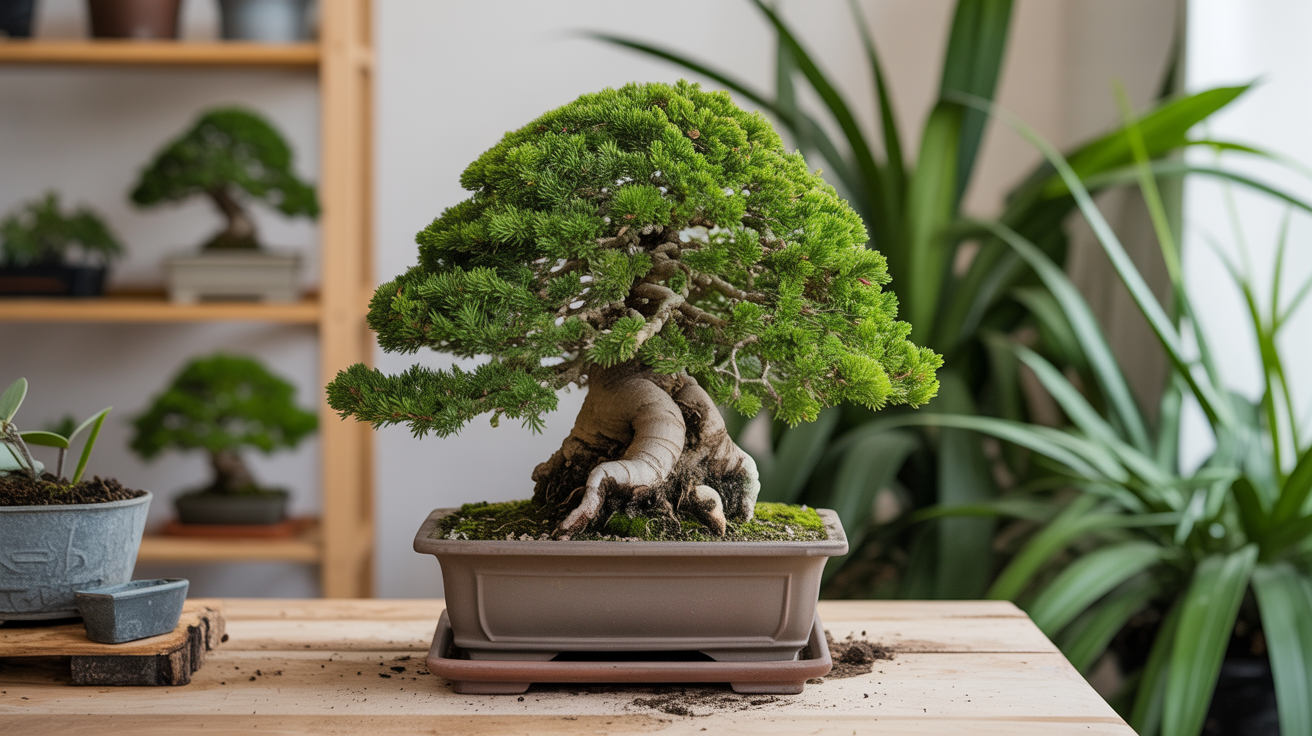
The clearest sign is visible roots. If you see roots circling the inside of the pot, pushing out of the drainage holes, or mounding up above the soil surface, the tree is telling you it has run out of room.
Water behavior is another indicator. Pour water over the soil and watch what happens. If it sits on the surface for a moment and then mostly flows around the edges instead of soaking in evenly, the root mass has become dense enough to resist absorption. Some very compact soils can cause this too, so cross-check with other signs.
Here are the main things to watch for:
- Roots emerging from drainage holes
- Roots visible above the soil line
- Water pooling on the surface before running off fast
- Slower-than-usual growth during the growing season
- The tree looking noticeably stressed despite regular watering and feeding
One more check: gently lift the tree out of its pot (or tilt the pot and ease the root ball out slightly). If the roots have formed a dense mat that holds the shape of the pot, it is time.
The best time of year to repot a bonsai
Early spring is the standard answer, and it is right for most trees. Specifically, repot just before the buds begin to swell and open. At that moment the tree has built up energy reserves during winter dormancy and is about to push into active growth. A repot done then gives the roots a few weeks to recover before the tree has to support a full flush of new leaves.
The underlying logic matches general nursery practice for root-disturbed stock. University of Minnesota Extension advises planting bare-root and freshly root-worked stock in early spring before growth begins, specifically because plants with disturbed or cut roots suffer the most transplant stress and need the shortest possible gap between root work and the recovery push of new growth. A bonsai repot, where you deliberately cut back a third of the root mass, is functionally the same kind of root disturbance on a much smaller scale, so the same early-spring logic applies.
Repotting in summer, when the tree is in full growth and under heat stress, is harder on the tree. Late autumn repots are possible for some species but generally riskier because the tree is heading into dormancy and repair is slower.
Tropical and subtropical bonsai, the kind often sold as indoor trees (ficus, jade, Fukien tea), do not go dormant the way temperate trees do. For these, late winter to early spring still works well as long as you keep the tree warm and out of direct sun while it recovers.
A practical rule: if you are unsure of the species, aim for late February to mid-April in temperate climates. That window covers the majority of commonly kept trees.
How often to repot a bonsai
There is no single right answer, because it depends on the species, the pot size, and the tree's age.
| Tree stage | Typical repotting interval |
|---|---|
| Young, fast-growing tree (under 10 years) | Every 1 to 2 years |
| Mature, established tree | Every 3 to 4 years |
| Old, slow-growing tree | Every 4 to 5 years |
| Tropical indoors (ficus, jade, etc.) | Every 2 to 3 years |
These are starting points. The roots tell you more than any calendar. Check the root mass every spring by gently easing the tree out of its pot. If the roots look loose with space around them, put it back and check again next year.
Young trees in development get repotted more often partly to encourage growth, partly because they fill their pots faster. A finished display tree that you are just maintaining can go longer between repots.
What to do when you repot
Once you have decided it is time, the actual process matters as much as the timing. A detailed walkthrough is in the step-by-step repotting guide, but briefly:
- Ease the tree out of its pot and remove the old soil from the roots with a root hook or chopstick, working gently.
- Trim the roots back by roughly a third. This is normal and necessary. A guide to root pruning safely covers the specifics in more detail.
- Clean the pot (or switch to a new one) and add fresh bonsai soil.
- Repot the tree, wire it in if needed to keep it stable, and water thoroughly.
- Keep the tree in a sheltered spot out of direct sun and wind for two to four weeks while it recovers. Do not feed it during this period.
The recovery window is important. Even a healthy repot puts the tree under mild stress. Shade and calm conditions let it settle in without extra demands. Here is roughly what that recovery period looks like in practice:
| Time after repotting | What to do | What to expect |
|---|---|---|
| Day 0 | Water thoroughly, move to shade and shelter | Soil settles, no visible change in the tree |
| Days 1 to 14 | Keep shaded, sheltered from wind, watered as normal | Little visible growth, this is normal |
| Weeks 2 to 4 | Still no fertilizer, gradually reintroduce filtered light | First new buds or leaf growth should appear |
| Week 4 onward | Move back to normal light, resume feeding once new growth is clear | Regular growing-season care resumes |
If you are considering a new pot as part of this, it helps to think about the pot choice before you start. The guide to choosing a bonsai pot covers size, depth, shape, and how to match them to the tree.
Common mistakes beginners make
Repotting too often is a real issue. Some beginners repot every year regardless of whether the roots need it, thinking more is better. It is not. Unnecessary repots stress the tree without benefit.
Repotting at the wrong time of year is the other common mistake. A summer repot on a stressed tree, or a repot right before a cold snap, can set back a tree significantly. If you miss the spring window, wait until next year rather than forcing it at the wrong time.
Using regular potting compost instead of proper bonsai soil is also a problem. Standard potting mix holds too much water and breaks down quickly, turning to a dense muck that suffocates roots. Bonsai soil mixes (typically akadama, pumice, and lava rock) drain well and support healthy root development.
Finally, do not neglect the recovery period. Moving a freshly repotted tree straight back into full sun and wind is a recipe for die-back.
Frequently asked questions
Can I repot a bonsai that I just bought?
It depends. Many nursery bonsai are sold in substandard soil that benefits from changing, but if you just bought the tree, it has already been stressed by the move. Give it two to four weeks to settle in your conditions before doing anything. If it arrives in early spring, repotting that first season is reasonable once it has settled. If it arrives in summer, wait until next spring.
What happens if I repot at the wrong time of year?
The tree may drop leaves, show wilting, or grow very slowly. In mild cases it recovers. In bad timing with a weak tree, it can be fatal. This is why spring repotting is strongly preferred. If you repot in the wrong season accidentally, focus on recovery: shade, minimal watering, no feeding, no further disturbance.
Do I always have to trim the roots?
Yes, unless the roots have very little growth at all (unlikely if the tree needed repotting). Root pruning keeps the tree in scale with its pot and stimulates fresh fibrous root growth. Skipping root pruning and just refreshing soil misses part of the point. The general guideline is to remove roughly a third of the root mass.
How do I know if the repot worked?
A healthy tree will push new growth within a few weeks of repotting, usually by the two to four week mark based on the recovery timeline above. That is your green light. If the tree sits dormant far longer than usual or shows wilting that does not resolve with watering, something went wrong, and it is worth taking a closer look at the roots and soil moisture.
Does pot size affect how often I need to repot?
Yes. A tree in a small, shallow pot fills it faster and needs repotting more often. A tree in a larger pot has more room to grow before the roots become crowded. This is one reason development-stage bonsai are sometimes kept in larger grow pots or training containers. Once a tree reaches its target size and pot, the repotting interval typically lengthens.
Can I repot two trees at once, or does each need its own recovery window?
Each tree needs its own recovery window regardless of how many you repot in a session. There's no harm in repotting several trees on the same afternoon since the work itself doesn't interact between trees, but give each one its full two to four weeks of shade and shelter afterward rather than assuming a batch of trees recovers on a shared timeline. Slower species or older trees may need the longer end of that range.